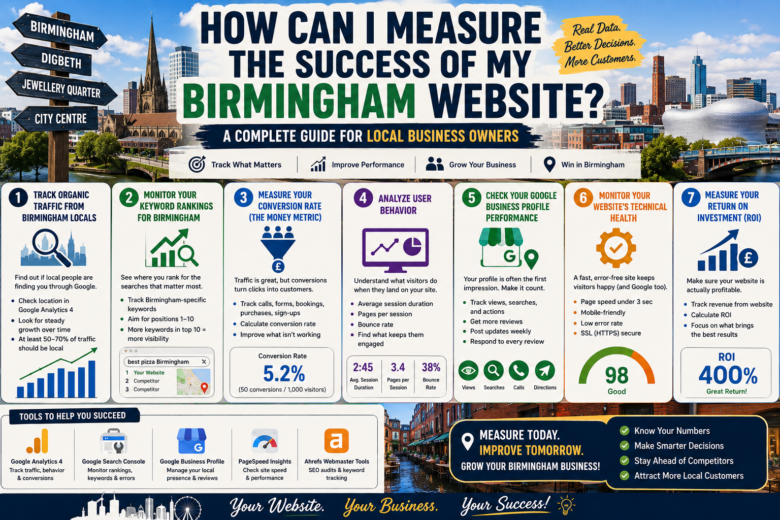
Let’s be honest: launching a website is like opening a shop in the middle of Birmingham without any windows or doors to see if people are walking in. You’ve built something beautiful, but how do you know if it’s actually working? That’s exactly what we’re going to figure out together today.
Measuring your Birmingham website’s success isn’t about guessing or feeling proud because you got a cool logo. It’s about looking at real data that tells you whether locals are finding you, loving your content, and most importantly—becoming customers. Whether you run a café in Digbeth, a law firm in the City Centre, or a gym in Solihull, these metrics apply to you.
Ready to stop wondering and start knowing? Let’s dive into the7 most important ways to measure your Birmingham website’s success.
1. Track Your Organic Traffic from Birmingham Locals
The first thing you need to know is: are people in Birmingham actually finding your website through Google? This is called organic traffic, and it’s the lifeblood of any successful local website.
Why Local Traffic Matters
When someone searches “best pizza Birmingham” or “plumber near me” in the Birmingham area, you want your website to show up. If you’re getting traffic from New York or Tokyo but zero from Birmingham, your website isn’t doing its job for your local business.
How to Check It
Use Google Analytics 4 (it’s free!) and follow these steps:
- Go to Reports > Audience > Location
- Set the location filter to “United Kingdom > England > Birmingham”
- Look at your organic traffic segment (not paid ads)
You should see a steady increase over time. If your Birmingham traffic is flat or dropping, that’s a red flag. Smart businesses check this monthly and adjust their SEO strategy accordingly.
What’s a Good Number?
There’s no magic number, but here’s what to watch:
- Growing trend: Your Birmingham traffic should increase month-over-month
- Percentage: At least 50-70% of your total traffic should be from Birmingham if you’re a local business
- Quality: People from Birmingham should spend more time on your site than visitors from other locations
2. Monitor Your Keyword Rankings for Birmingham-Specific Searches
You might be getting traffic, but are you showing up for the right searches? This is where keyword rankings come in.
The Birmingham Keyword Strategy
Think about what your customers actually type into Google:
- “Birmingham website designer”
- “coffee shop Birmingham city centre”
- “emergency plumber Birmingham”
- “best Thai food Birmingham”
These are your Birmingham-specific keywords. You need to track where your website ranks for these exact terms.
How to Track Rankings
Use tools like:
- Google Search Console (free): Shows you which keywords bring people to your site
- Ahrefs or SEMrush (paid): Give you detailed ranking reports for specific locations
In Google Search Console, go to Performance > Search Results and look for keywords containing “Birmingham.” You’ll see your average position and how many clicks you got.
What to Look For
- Position 1-3: You’re in the golden zone. These rankings get 60%+ of all clicks
- Position 4-10: You’re visible but not dominating. Push harder with better content and SEO
- Position 11+: You’re basically invisible. Most people don’t scroll past page 1
The goal? Get more Birmingham keywords into positions 1-10. Track this monthly and celebrate when you climb up!
3. Measure Your Conversion Rate (The Money Metric)
Traffic and rankings are cool, but do they turn into actual business? That’s what conversion rate tells you.
What Is a Conversion?
A conversion happens when someone does what you want them to do:
- Books an appointment
- Makes a purchase
- Calls your business
- Fills out your contact form
- Downloads your brochure
- Signs up for your newsletter
For a Birmingham bakery, a conversion might be someone ordering a cake. For a Birmingham solicitor, it might be booking a consultation.
How to Calculate Conversion Rate
textConversion Rate = (Number of Conversions ÷ Total Visitors) × 100
Example: If 1,000 Birmingham visitors came to your site and 50 booked appointments:
text(50 ÷ 1,000) × 100 = 5% conversion rate
How to Set Up Tracking
In Google Analytics 4:
- Go to Admin > Events
- Mark important actions as “conversions” (form submissions, button clicks, etc.)
- Set up destination goals for pages like “/thank-you” after someone completes an action
You can also use Google Tag Manager to track specific buttons like “Call Now” or “Book Appointment”.
What’s a Good Conversion Rate?
Industry averages vary, but here’s a general guide:
- Website: 2-5% is normal
- E-commerce: 1-3%
- Service businesses: 5-10%
- High-performing sites: 10%+
If your Birmingham conversion rate is below 2%, you need to improve your website’s user experience, messaging, or call-to-action buttons. If it’s above 5%, you’re doing great!
4. Analyze User Behavior: How Long Do Birmingham Visitors Stay?
People are visiting your site, but are they sticking around or bouncing away? User behavior metrics reveal the truth.
Key Behavior Metrics to Watch
Why These Matter for Birmingham Businesses
If Birmingham visitors spend less than 30 seconds on your site, they’re not interested. But if they’re reading 3-4 pages and staying for 3+ minutes, they’re eng
aged and probably considering your services.
How to Check Behavior Data
In Google Analytics 4:
- Go to Reports > Engagement
- Filter by location = “Birmingham”
- Look at Average Session Duration, Pages per Session, and Bounce Rate
You can also create a custom report focusing only on Birmingham users to see their specific behavior patterns.
Red Flags to Watch For
- Bounce rate above 60%: Your content isn’t matching what people searched for
- Session duration under 30 seconds: Your site is confusing or uninteresting
- High exit rate on contact page: People can’t find how to contact you
Fix these issues by improving your headlines, adding clear CTAs, and making navigation simpler.
5. Check Your Google Business Profile Performance
For Birmingham businesses, your Google Business Profile (formerly Google My Business) is just as important as your website. It’s what shows up when people search “near me” in Birmingham.
What Metrics to Track
Your Google Business Profile dashboard shows:
- Views: How many people saw your profile
- Searches: How many found you via Google Search vs. Maps
- Actions: How many clicked your website, called you, or requested directions
- Reviews: New reviews and your overall rating
Why This Matters
76% of people who search for something local on Google visit within 24 hours. If your Birmingham Google Business Profile isn’t performing, you’re missing huge opportunities.
How to Improve It
- Add high-quality photos of your Birmingham business
- Post weekly updates about events, offers, or news
- Respond to all reviews (positive and negative) within 24 hours
- Keep your hours, address, and phone number accurate
- Use Birmingham-specific keywords in your business description
Track your profile performance monthly. You should see steady growth in views and actions.
6. Monitor Your Website’s Technical Health
A beautiful website that crashes or loads slowly will lose Birmingham customers faster than you can say “Stratford Arc.” Technical SEO matters more than you think.
Critical Technical Metrics
How to Check Technical Health
Use these free tools:
- Google PageSpeed Insights: Tests your load speed
- Google Search Console: Shows errors and mobile issues
- Screaming Frog: Finds broken links and technical problems
In Search Console, check:
- Pages > Not Found: Fix broken links
- Mobile Usability: Ensure Birmingham mobile users can navigate easily
- Security Issues: Make sure your site is safe
Quick Fixes That Move the Needle
- Compress images (use tools like TinyPNG)
- Enable caching on your server
- Use a fast hosting provider (avoid cheap shared hosting)
- Add a CDN (Cloudflare works great)
If your Birmingham website loads in under 3 seconds on mobile, you’re in the sweet spot.
7. Measure Your Return on Investment (ROI)
Finally, the big question: is your Birmingham website actually profitable? ROI tells you if your investment is paying off.
How to Calculate SEO ROI
textROI = [(Revenue from Website - Cost of Website) ÷ Cost of Website] × 100
Example:
- Revenue from Birmingham website: £50,000
- Cost (design, hosting, SEO, content): £10,000
- ROI = [(50,000 – 10,000) ÷ 10,000] × 100 = 400% ROI
What Costs to Include
- Website design and development
- Hosting and domain fees
- SEO tools and software
- Content creation (blog posts, descriptions)
- Paid advertising (if you run Google Ads)
- Maintenance and updates
What Revenue to Track
- Direct online sales
- Value of booked appointments (multiply by average conversion value)
- Phone calls generated (track with call tracking software)
- Email signups that become customers later
Use Google Analytics 4 with enhanced measurement to track revenue. Set up purchase events for e-commerce or lead value for service businesses.
When ROI Is Positive
- 0-100% ROI: You’re breaking in
- 100-300% ROI: You’re doing well
- 300%+ ROI: You’re crushing it!
Most Birmingham websites hit positive ROI within 6-12 months if you’re doing SEO right.
Your Birmingham Website Success Checklist
Here’s your quick action plan to measure everything:
Monthly Tasks
- ✅ Check Birmingham organic traffic in Google Analytics
- ✅ Review keyword rankings for Birmingham-specific terms
- ✅ Calculate conversion rate and total conversions
- ✅ Analyze user behavior (session duration, bounce rate)
- ✅ Monitor Google Business Profile stats
- ✅ Check technical health (speed, errors, mobile)
Quarterly Tasks
- ✅ Calculate full ROI
- ✅ Adjust SEO strategy based on data
- ✅ Update content for trending Birmingham topics
- ✅ Audit and fix broken links
Tools You Need (All Free or Low-Cost)
- Google Analytics 4 – Traffic, conversions, behavior
- Google Search Console – Keywords, rankings, errors
- Google Business Profile – Local visibility
- PageSpeed Insights – Load speed
- Ahrefs Webmaster Tools – Free SEO audit
Data Drives Birmingham Success
Measuring your Birmingham website’s success isn’t complicated—it’s just about looking at the right numbers. Stop guessing and start tracking these 7 metrics:
- Organic traffic from Birmingham
- Keyword rankings for local searches
- Conversion rate
- User behavior metrics
- Google Business Profile performance
- Technical health
- ROI
When you track these consistently, you’ll know exactly what’s working and what needs fixing. You’ll spot problems before they become disasters. You’ll see growth before your competitors do. And most importantly, you’ll build a Birmingham website that actually brings in customers.
Remember: if you can’t measure it, you can’t improve it. So grab those tools, set up your tracking, and start measuring today. Your Birmingham business will thank you for it.
Got questions about which metric matters most for your specific Birmingham business? Drop them below, and let’s chat about making your website the best it can be! 🚀